

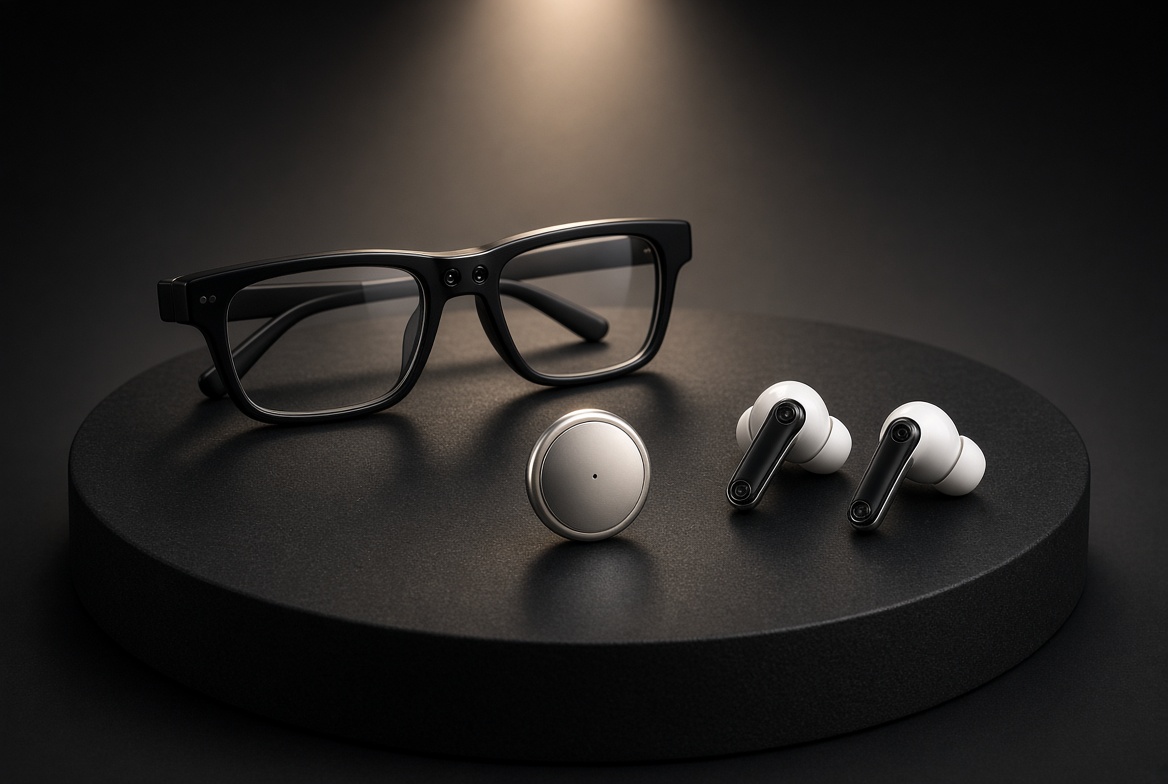
Three Sensors for One Assistant: Apple Accelerates Glasses, a Pendant, and Camera AirPods
Updated September 2026.
Mark Gurman’s Bloomberg report this week is not a product launch. It is Apple telling its own people, after an all-hands in which Tim Cook said the company is “extremely excited” about new product categories, that Siri will get eyes that do not live on a phone screen.
Three devices. All cameras. All tied to the iPhone.
The Information described a pin in January. Gurman this week folded it into a program, and gave each device a job.
Quick specs
- Maker
- Apple
- Category
- AI wearables — cameras for Siri
- The trio
- Smart glasses · Pendant · Camera AirPods
- Glasses
- 2 cameras, no display · launch 2027
- Pendant
- AirTag-sized · camera + mic · may be cancelled
- AirPods
- Low-res / IR cameras · as early as 2026
- Brain
- iPhone + rebuilt Siri (Gemini)
- Source
- Bloomberg / Mark Gurman, Feb 2026
- Status
- Reported roadmap, not announced
Device one: the glasses
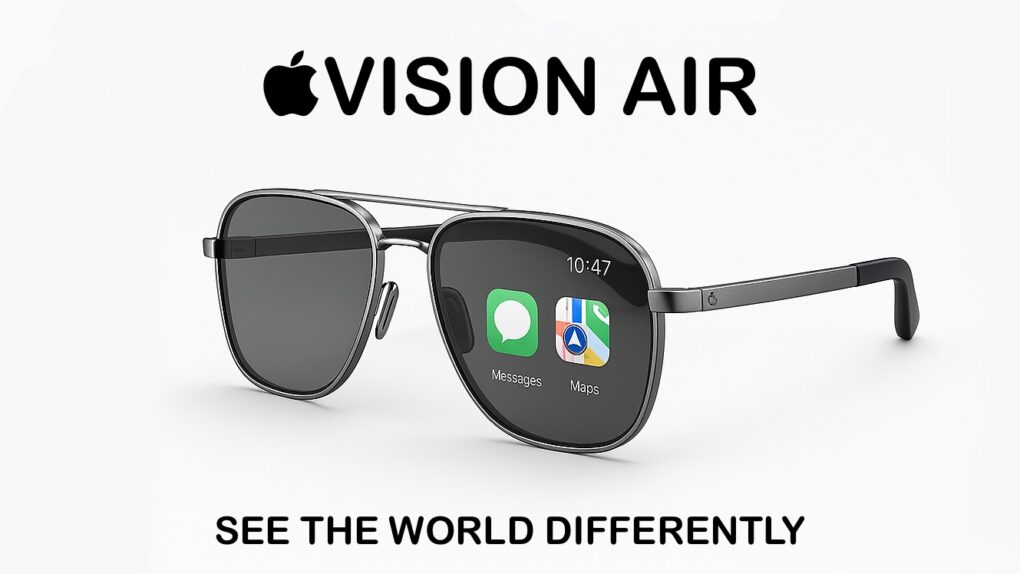
Concept render — Apple smart glasses
The smart glasses are the most advanced of the three and the only one with a production target. Gurman puts the start of manufacturing as early as December, with a consumer launch in 2027. They carry two cameras, speakers, and microphones, and no display in the lens.
The camera split is the detail worth keeping. One camera is high resolution, for photos and video. The second exists to feed Siri: computer vision, environmental context, what you are looking at and what you are doing. Apple’s stated goal, per the report, is an all-day AI companion. Look at an object, ask what it is, get help with the task in front of you.
What the glasses are not matters just as much. Gurman says glasses with a built-in display remain many years away. Meta already sells that product, the Ray-Ban Display with its in-lens panel and Neural Band, at $799. Apple’s first answer to it is a pair of glasses that cannot show you anything.
Device two: the pendant
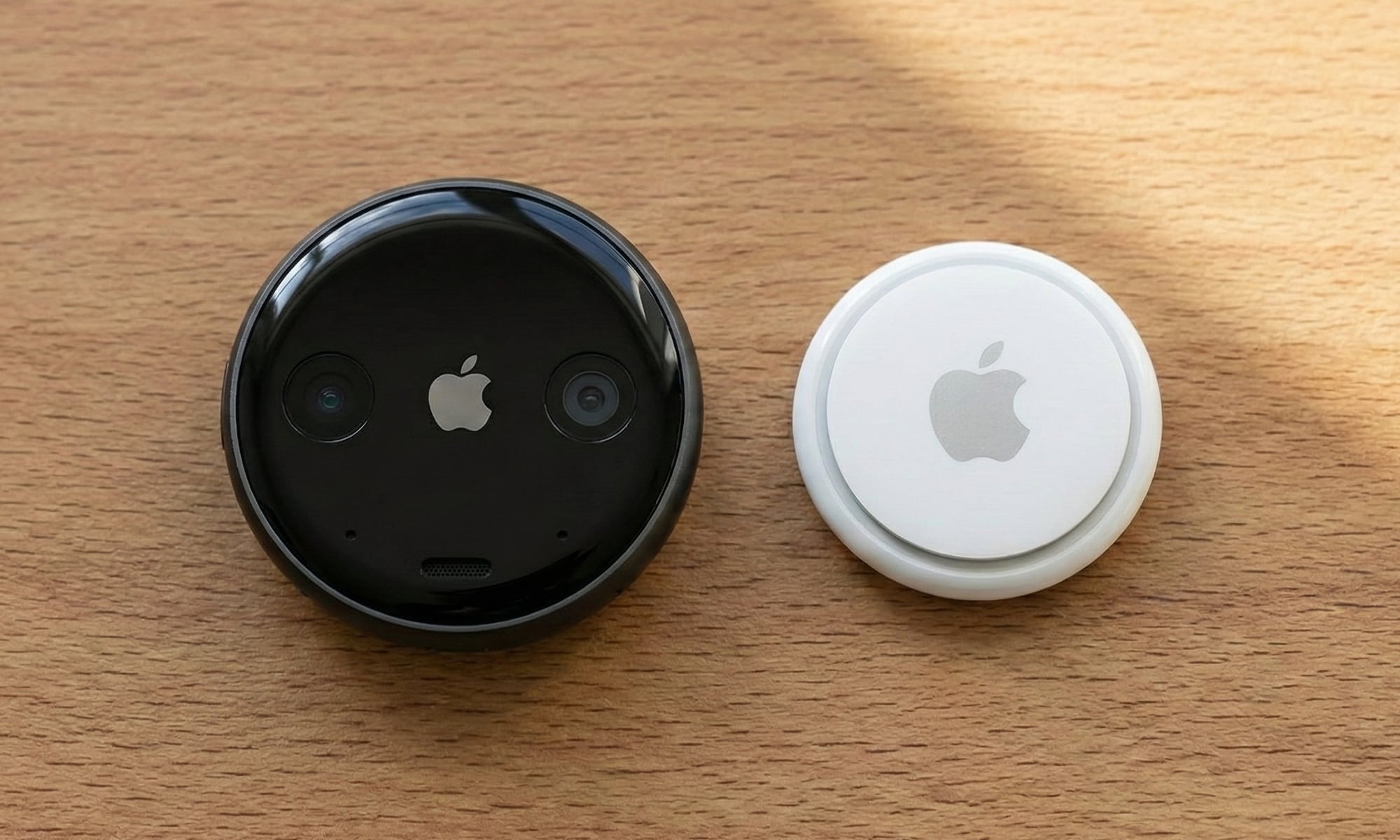
Concept — the AirTag-sized pendant
The pendant is the size of an AirTag, a flat aluminum disc with glass, designed to clip to clothing or hang from a necklace. Inside is a camera, a microphone, and a chip in the class of AirPods or Apple Watch. The iPhone does most of the processing.
Apple employees, per the report, already have a nickname for it: the “eyes and ears” of the iPhone. That phrase is the strategy. The pendant does not replace the phone. It is an always-on camera for the phone, feeding Visual Intelligence and the rebuilt Siri so you can ask about what is in front of your chest without taking the phone out.
The open question inside Apple is whether it gets a speaker. That is not a component debate. It is a product definition debate. With a speaker, you could hold a conversation with the pendant and leave both the iPhone and the AirPods behind. Without one, the pendant is a sensor that answers through other devices. The first version drifts toward Humane. The second stays an accessory.
Gurman says the pendant is early and could still be cancelled. Treat that sentence as part of the spec.
Device three: the AirPods
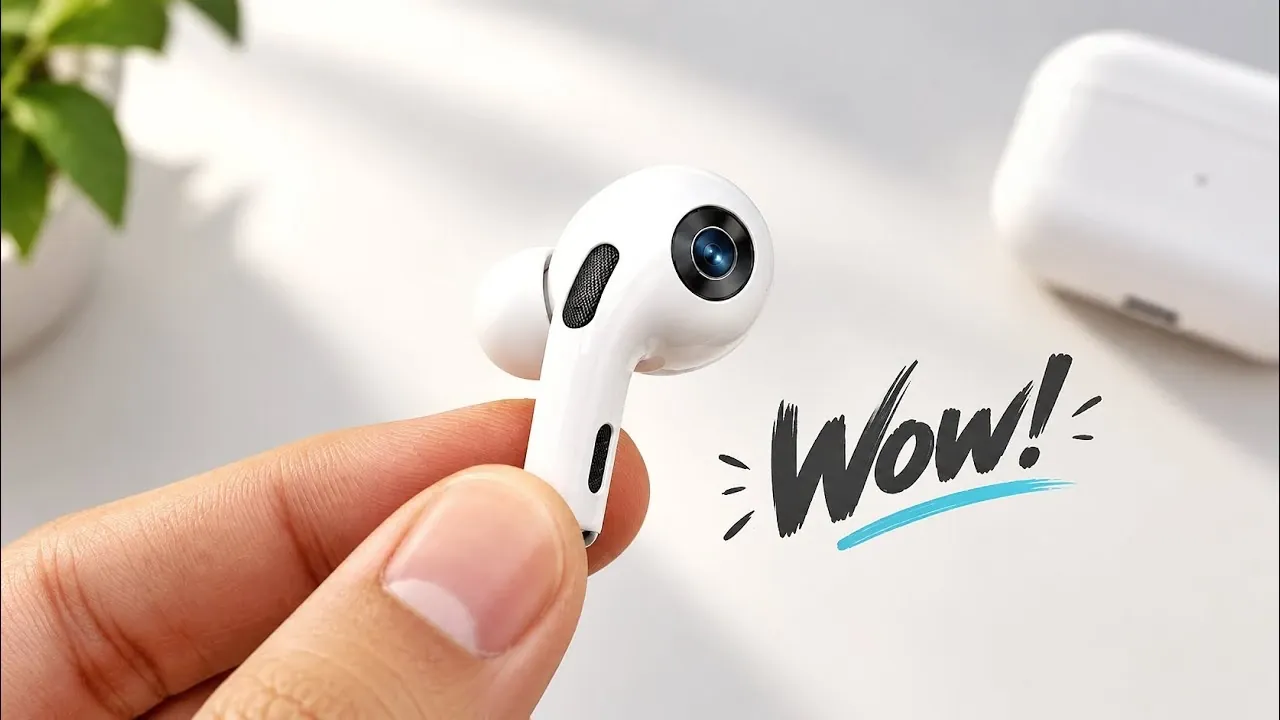
Concept — camera AirPods
The AirPods are the least defined and the most Apple. The reported cameras are low resolution, possibly infrared, and they are not for photography. They exist to give the assistant a view of the world. The timing in the report points to as early as later this year.
The logic is simple and ruthless: put a camera on a product people already wear all day, and do not ask them to clip anything to a shirt. Gurman has described the idea before as giving people many of the benefits of smart glasses without lenses and frames. It is also the camera nobody around you will notice, which is its own problem, and one this week’s report does not address.
What the trio actually is
It is not three computers. It is three places to hang a sensor for one assistant.
Read together, the devices describe a single architecture. The iPhone is the brain. Siri is the interface. The glasses, the pendant, and the AirPods are mounting points for cameras at three heights on the body: the eyes, the chest, the ears. None of them is designed to work alone.
Apple has walked this road before and turned back once. Gurman reported last year that Apple had been developing an Apple Watch with a camera for the same reason, to give its AI a view of the world, and that work was put on hold. The wrist camera died. The face, the chest, and the ears are the second attempt.
The pin that died, and the pin Apple will not build
The form of the pendant will be compared, correctly, to the Humane Ai Pin.
That device was built by Imran Chaudhri and Bethany Bongiorno, two former Apple people who founded Humane in 2018 on an explicit brief: undo the screen. The Pin shipped in April 2024 at $699 plus a $24 monthly cellular subscription. It projected an interface onto the palm. It tried to be a phone. It sold on the order of 10,000 units. In February 2025 Humane shut the servers. HP bought the company’s remnant, the team, CosmOS, and the patents, for $116 million. The Pin itself was discontinued.
Gurman’s own framing this week is that Apple’s object is reminiscent of that pin, and then the report refuses its thesis. No projector. No display. A chip that hands the heavy work to the iPhone. Nothing in the report suggests a modem or a monthly plan. The iPhone does the work.
That is not a wink to two alumni. It is Apple declining the only idea that made their startup exist. The category, from Limitless to Friend, Bee, and Plaud, already decided that a chest camera is interesting, and Meta bought Limitless in December to own a piece of it. Humane decided the chest camera should replace the slab. Apple is building the version that protects the slab.
If you write “Apple copies Humane,” you are describing the silhouette and missing the product. If you write “Apple ignored the failure,” you are missing the silhouette. Both belong in one paragraph. Not in the headline.
The gap with Meta is the article
Meta’s week at CES was a wrist that types and a lens that reads. The Neural Band is an input device that can, in principle, follow the user onto other frames. Meta is trying to make the phone less necessary for the next thirty seconds of a message.
Apple’s three devices do the opposite. They make the phone more necessary. Glasses without a display have nowhere to put a reply except the ear and the phone. A pendant with AirPods-class silicon has nowhere to run Siri except the phone. Camera AirPods see for an assistant that still lives in iOS.
That is a coherent architecture, and it plays to Apple’s real advantage. Meta has to build a platform on top of someone else’s phone. Apple owns the phone, the chip, the operating system, and the assistant. Every new sensor makes the iPhone harder to leave.
The software the hardware is waiting for
It is also a bet that people will accept three new cameras on the body in order to talk to an assistant that, as of this month, is still being rebuilt.
The history matters here. Apple announced the personalized Siri at WWDC in June 2024, then delayed it. In January, Apple confirmed that Google’s Gemini will power the next generation of Siri. The first beta of iOS 26.4, where the new Siri is supposed to begin appearing, landed on Monday, one day before this report. The assistant that all three devices exist to serve has not yet shipped to a single customer.
The hardware roadmap is moving faster than the software it exists to serve. That is the risk Cook’s “extremely excited” does not price.
Privacy is the other unpaid invoice. An always-on chest camera from the company that sells privacy is a product contradiction until the retention policy, the indicator LED, and the on-device versus cloud split are public. They are not. Camera AirPods make it harder, not easier: a lens in the ear is a lens most people will never notice. A rumor is allowed to be incomplete. A ship date is not.
Verdict
Do not inventory these as three future SKUs. Inventory them as one system: Siri gets a body. The glasses are the socially acceptable camera. The AirPods are the camera nobody has to explain. The pendant is the camera that still needs a new habit, clipping metal to a shirt, and is therefore the first one Apple will be willing to kill.
Meta is building a stack that can leave the phone in the bag. Apple is building a stack that makes the bag smarter. Which one wins is not a 2026 question. Whether Apple ships two of the three without shipping a competent assistant is.
On September 22, Bloomberg reported that Apple has postponed the camera pendant, with no new ship window and no stated reason. The glasses and the camera AirPods remain in development, with the AirPods now pointed at 2027. Bloomberg also reported early prototypes of a screen-free health band in the Whoop direction, not before 2028.
The rest of the program moved in the direction the February text warned about. In April, Gurman added detail on the glasses: four acetate frame shapes in testing, designed in-house rather than with Luxottica. By May, the glasses had slipped to late 2027, because Apple wanted its visual AI ready first. By July, privacy work was reported as a main reason for the delay, with an unveiling now planned for WWDC in June 2027 and consumer availability by the end of that year. Software and privacy, the two unpaid invoices from February, turned out to be the schedule.
The software did arrive in the meantime. Apple introduced Siri AI at WWDC this June. The assistant now exists. The bodies for it are still a year away.
The pendant was the device that required a new wearing gesture. The glasses and the AirPods sit on habits that already exist. When a rumor says “could still be cancelled,” believe the clause.
Want the same rigor applied to your own AI system?
That’s what a QAi Health Check is for.