

The Keyboard Moves Into the Wrist: Meta’s Neural Band at CES
Updated September 2026.
RayNeo spent the week arguing that glasses become a computer when they get a radio. Meta spent the same week arguing they become a computer when the hand stops needing a screen.
The hardware is not new. Ray-Ban Display shipped last fall with a monocular in-lens panel and a wristband that reads muscle signals. What Meta put on the CES calendar on January 6 is software that finally uses that band as an input device rather than a remote control: neural handwriting and a teleprompter you advance with a gesture.
That pairing is the story. Face as display. Wrist as keyboard. Phone optional for the thirty seconds it takes to send a message.
Quick specs
- Maker
- Meta
- Category
- AR glasses + EMG wristband
- Devices
- Ray-Ban Display + Neural Band
- Display
- 600×600 monocular, in-lens
- Input
- Surface EMG — neural handwriting + gestures
- New at CES
- Teleprompter; neural handwriting (Early Access)
- Availability
- US only, English, WhatsApp & Messenger
- Also shown
- Garmin in-car control (PoC)
- Status
- Hardware shipped; input software rolling out
What actually shipped this week
Two features. Different maturity.
Teleprompter begins a phased rollout now. You paste notes or a script from the phone, up to 16,000 characters, roughly half an hour of speech, and they appear as text cards in the 600×600 display. The Neural Band advances the cards. The person across the table does not see a prompt. Meta’s own copy calls it discreet. That is accurate and is also the product risk.
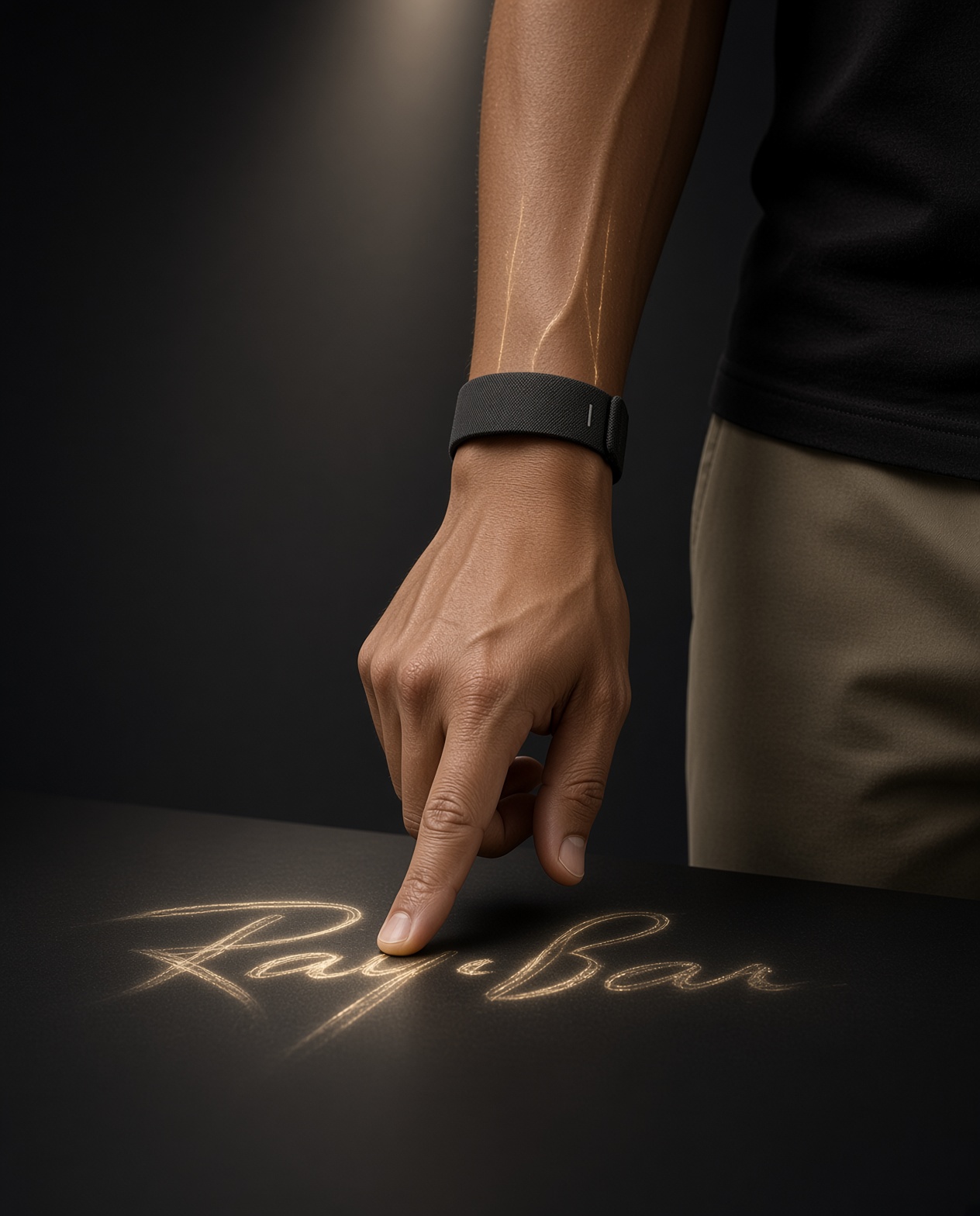
Neural handwriting opens in Early Access in the United States, English only, WhatsApp and Messenger only. You trace letters with a finger on a table, a thigh, an armrest. The band does not watch the finger with a camera. It reads surface EMG, the electrical activity in the forearm as motor commands travel to the hand. Meta transcribes the gesture into a message, or offers a suggested reply. The official line: “the only wrist device that enables neural handwriting on any surface.”
Pedestrian navigation also adds Denver, Las Vegas, Portland, and Salt Lake City, for 32 cities. That is incremental. The band is not.
In the same post, Meta paused its planned expansion of Ray-Ban Display to the UK, France, Italy, and Canada, citing US demand that outran inventory. The new input methods therefore land on a device most of the world still cannot buy.
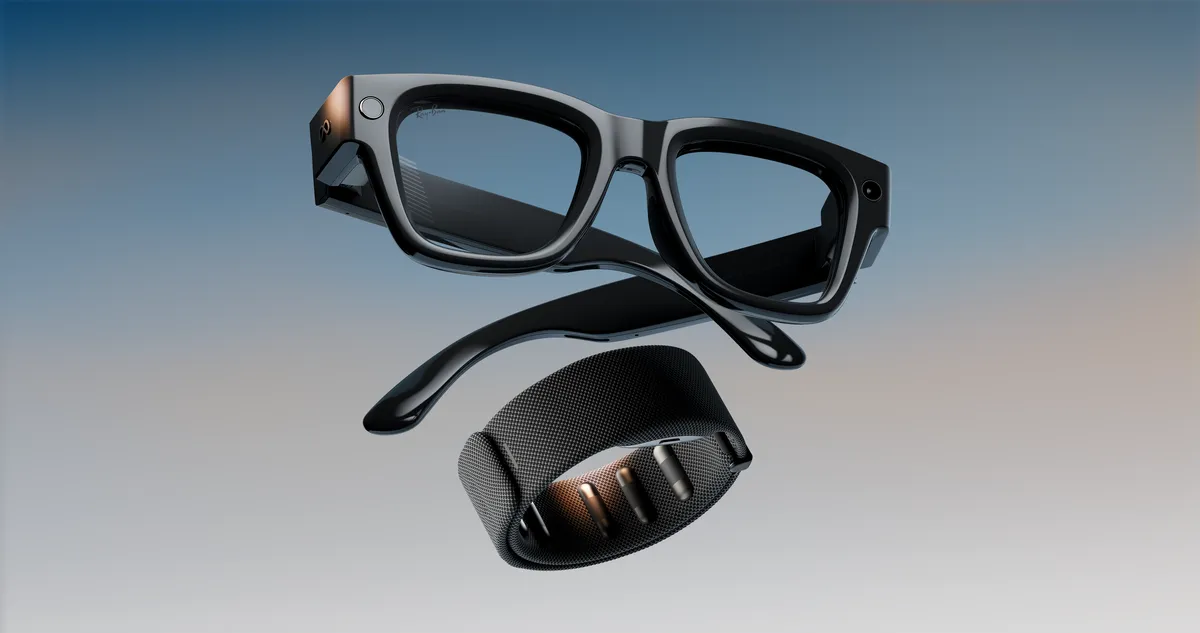
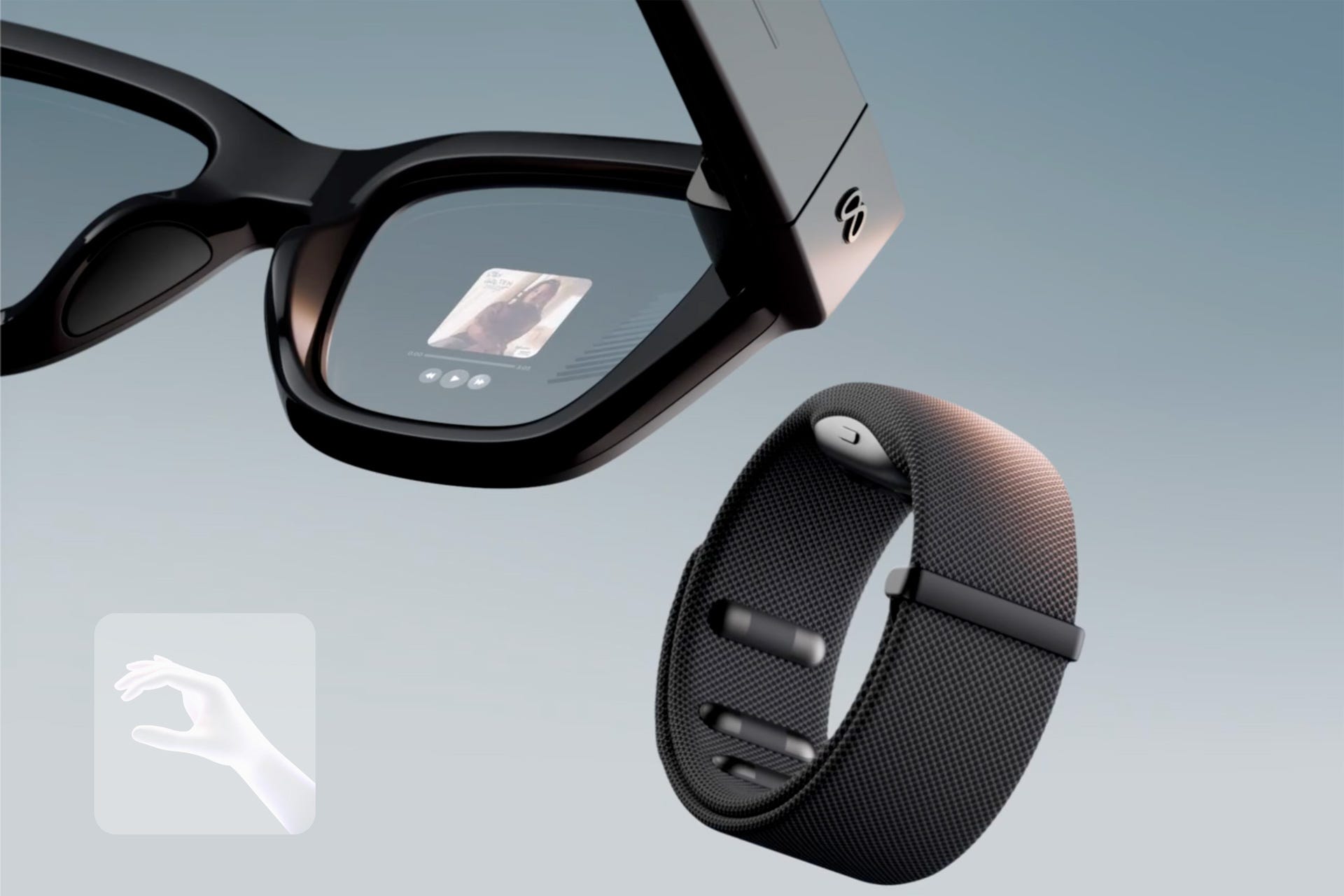
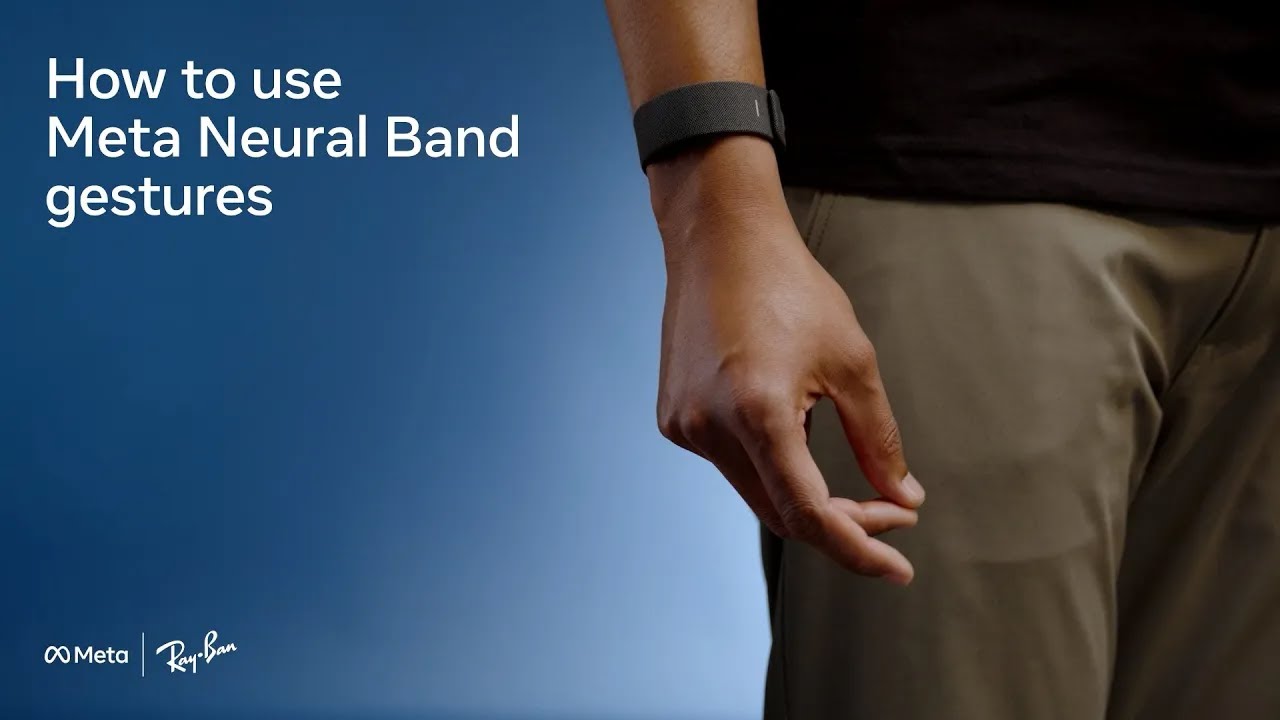
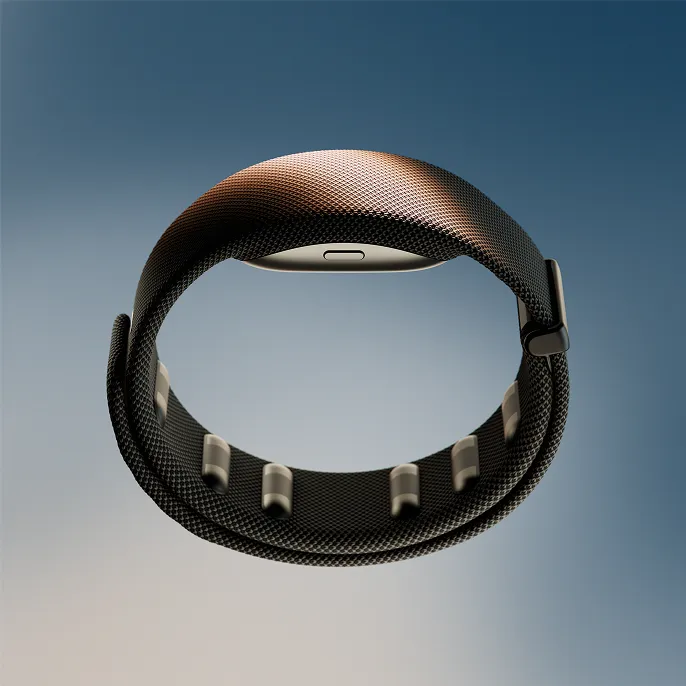
Meta Ray-Ban Display and the Neural Band.
Why EMG is a different class of input
Camera gesture systems fail when the hand leaves the frame, when the room is dark, when you keep your hands in a coat. A wristband that listens to muscle does not need a line of sight. You can write on fabric. You can write with the hand at your side, which is exactly how Meta’s announcement describes it.
Meta’s own help page tells a more careful story. Anchor the wrist on a hard surface. Use the index finger. Print, do not write in cursive. Keep a steady pace. The distance between “hand resting at your side” in the keynote and “wrist anchored on a hard surface” in the manual is the distance between demo and habit.
The important architectural claim is not “no phone.” The phone still pairs, still holds the script, still owns WhatsApp. The claim is no gaze on glass. Head up. Eyes on the room. Text happens at the edge of the body.
That is the opposite of every pin and clip on the CES floor that wants you to talk to a microphone in public. Voice is an interface that announces itself. Finger-on-trousers is an interface that hides.
Hidden input is useful in a meeting and corrosive in a conversation if the other person cannot tell you are writing. The teleprompter makes the same bargain in the other direction: you look engaged while you read. Both features optimize for appearing present. Neither is neutral.
The system Meta is actually building
CES did not launch a new band or a new frame. It launched a control loop. The glasses hold a small private screen. The band holds the pointing device and now the character generator. The phone remains the identity, the app graph, and the paste buffer.
Meta’s automotive proof of concept with Garmin extends the same loop into a car. Passengers scroll and pinch through Garmin’s Unified Cabin infotainment from the wrist, launching apps and playing games. Meta’s head of wearables, Alex Himel, said the quiet part out loud: the band “could be the best way to control any device.” That is not a gadget add-on. It is Meta saying the Neural Band is a general EMG controller that happens to ship with glasses.
If that holds, the band becomes more important than the display. Displays will multiply: Meta’s own cheaper non-display glasses, everyone else’s AI frames. A wrist that already knows your pinch and your handwriting can follow you across those frames. The lock-in is not Ray-Ban. It is the trained mapping from your forearm to Meta’s decoder.
That is also the data question the keynote did not take. EMG is biometric-adjacent. It is a pattern of how your nervous system drives your hand. Meta’s CES materials say nothing about retention of raw EMG traces versus recognized gestures. For a product that now turns those traces into messages inside WhatsApp, that omission is the part a serious buyer should ask about before calling the band a keyboard.
Limits that belong in the same paragraph as the wow
This is Early Access, US only, English only, two chat apps. A lab feature with a CES headline.
Recognition quality on a moving train, under a winter sleeve, with the non-dominant hand, or with poor handwriting is not in the press kit.
The Display itself is still monocular, still a small panel, still a device Meta cannot keep in stock.
Suggested replies sit next to free handwriting. The easy path will be the model’s sentence, not yours. That is how keyboards decay into buttons.
None of that makes the demo fake. It makes the category early. EMG input that works at all on a consumer wrist is a real step. Shipping it narrowly on two messengers is how you collect the data to decide whether it is a keyboard or a party trick.
Verdict
RayNeo’s Project eSIM asks whether glasses can leave the phone’s radio. Meta’s Neural Band asks whether glasses can leave the phone’s keyboard.
This week Meta gave the more honest answer of the two, because the hardware is already on wrists and the feature is rolling, however narrowly. The hand is now a text field. The lens is now a cue card. The social cost of both is that other people lose the signal that you are operating a computer.
Write this down as the start of a body stack, not as the death of the phone. The phone still authenticates the chat. The wrist now types it. The face now reads it. Whoever owns the decoder on that wrist will own the next input layer. And unlike a radio in a frame, that decoder learns you.
The narrow launch widened fast. By May, neural handwriting had moved beyond WhatsApp and Messenger to Instagram and the native messaging apps on Android and iOS. By August, Early Access users could skip “Hey Meta” entirely and write their AI queries by hand. The keyboard verdict is moving in Meta’s favor. The data question from January is still unanswered, and it now covers every message and every query that passes through the wrist. Through the spring, the display glasses themselves remained a US-only product.
Want the same rigor applied to your own AI system?
That’s what a QAi Health Check is for.