

The $6.5 Billion Object That Will Not Arrive This Year
Updated September 2026.
OpenAI did not hold a keynote this week. It filed papers.
In a Monday motion tied to a trademark suit brought by the audio startup iyO, OpenAI told a court that its first consumer hardware device will not ship to customers before the end of February 2027. The filing, a sworn statement from Peter Welinder, OpenAI’s vice president and general manager, also says the company has produced no packaging and no marketing materials for that device, and that it has decided not to use the name “io”, or IYO, or any capitalization of either, on any AI hardware it sells.
That is the announcement. A device pushed out of 2026, and a brand retired before it printed a box.
Key facts
- Company
- OpenAI + io (Jony Ive)
- Acquisition
- io, May 2025 · ~$6.4–6.5B all-stock
- Device
- Unnamed “third core device” (concept)
- Ship date
- Not before end of Feb 2027 (court filing)
- Name
- “io” / IYO retired
- Sep 2026 update
- Reportedly a screenless smart speaker w/ camera · ~$200–300 · 2027
- Source
- OpenAI court filing (iyO suit), Feb 2026
- Status
- Announced roadmap, no product
What was supposed to happen in 2026
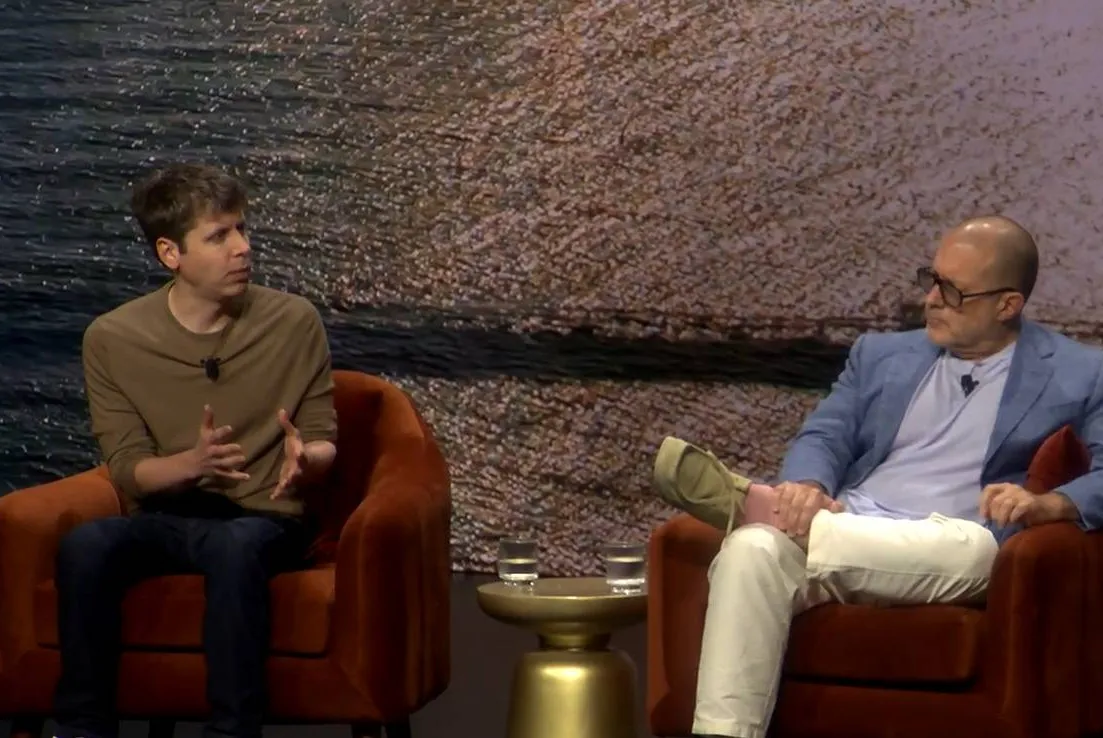
Sam Altman and Jony Ive
In May 2025 OpenAI bought io, the company Jony Ive started after Apple, in an all-stock deal valued at about $6.4 to $6.5 billion. The public story was a “third core device”: something that would sit in a pocket or on a desk next to a laptop and a phone, designed by the person who shaped the iPhone, running ChatGPT as the interface instead of an app grid.
The ambition was stated in numbers. In a conversation with staff that later leaked, Sam Altman set a goal of shipping 100 million devices faster than any company had ever shipped 100 million of something new. The promotional video that announced the deal promised to share the work in 2026.
Three weeks ago, that promise still held. At Davos in January, OpenAI’s chief global affairs officer, Chris Lehane, said the company was on track to unveil its first device in the second half of 2026, and called a late-2026 launch the most likely timeline. He also said “we will see how things advance.” This week, things advanced into a courtroom.
Meanwhile the vacuum did what vacuums do. January leaks from Asian supply-chain blogs floated earbuds, codenamed Sweetpea, worn behind the ear. Super Bowl weekend produced a polished fake ad: an actor, a pair of chrome earbuds, a reflective pebble, and the word “Dime.” OpenAI’s president Greg Brockman called it fake news within hours.
The court filing this week collapses the timeline without describing the object. That absence is the most honest spec sheet OpenAI has published.
What the filing actually settles
Three things, and only three.
Date. Not 2026. Not “holiday 2026.” Not before the last day of February 2027. A company that sells a weekly model update just told a judge its hardware calendar is annual.
Name. io was the acquisition, the studio, and the rumor label. It is now a legal liability. The product will launch, if it launches, under a name that does not exist yet. You cannot pre-order what you cannot search.
Maturity. No packaging. No marketing. That is not a stealth strategy. That is a device that has not been frozen hard enough to brief a printer.
Everything else remains where it was in May: inferred. Pocket or desk, screen or no screen, wearable or object, custom silicon or a phone tether.
There is one hard constraint on the record, and it is older than this week. In June 2025, in the same lawsuit, members of the io team told the court that the first device would be neither a wearable nor an in-ear product. Put that next to the Sweetpea leaks and something does not fit. Either the earbuds are not the first device, or the first device changed. Treat the sworn statement as the constraint and the leaks as noise. The category this site has been tracking still has an OpenAI-shaped hole in it. The hole just moved into 2027.
Why this belongs next to Apple and Meta
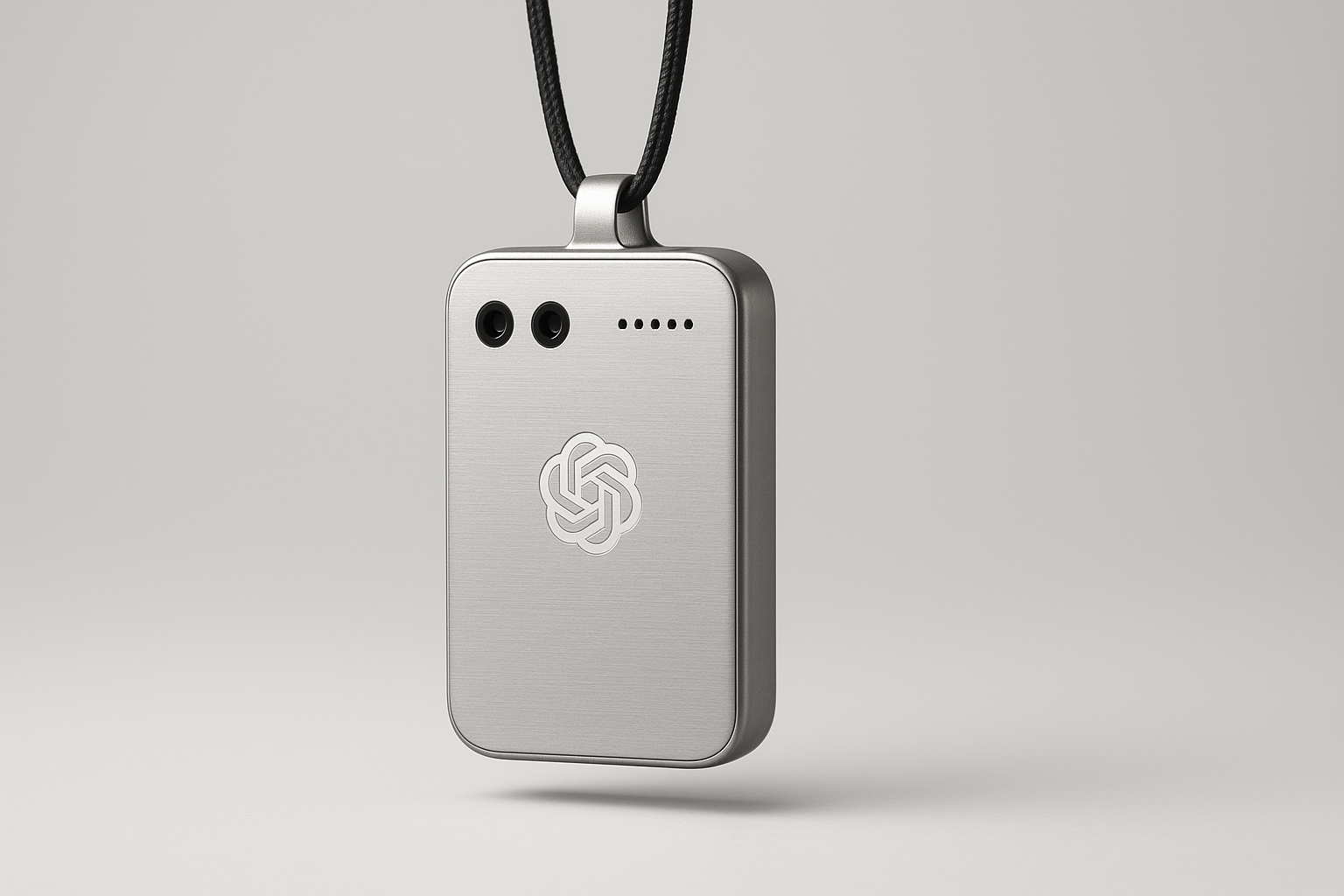
Concept render — not an official product
January gave this category two clear bets. At CES, RayNeo put a cellular radio in a frame, and Meta turned its wristband into a keyboard for glasses that are already on faces. In the same month, The Information reported that Apple is exploring an AirTag-sized pin of its own, on top of the smart glasses Bloomberg has been reporting for a year.
Meta and Apple are attaching sensors to objects people already wear, and routing them through ecosystems they already own. OpenAI paid Ive money to invent a new object, then discovered that inventing the object is the slow part. The model can be swapped in a release note. Injection molds cannot.
That is the production fact hiding under the valuation. Six and a half billion dollars bought a design studio and a story. It did not buy a supply chain, a radio certification, a battery that survives a pocket, or a reason for a stranger to carry something unnamed. Humane learned the last item the expensive way. OpenAI just bought itself time to avoid learning it in public in 2026.
The honest risk
Delay is not failure. Shipping a vague “third device” into a year when Meta already has glasses on faces and a wristband that writes, and when Apple is reportedly circling its own pin, would have been a different kind of failure. The Humane kind, with better lighting.
The risk that matters is simpler. Every quarter this object stays undescribed, the market fills with good-enough pendants, pins, buds, and frames that each do one job. By the time Ive’s device exists, “ambient AI” may already mean a few-hundred-dollar pair of glasses, not a $6.5 billion sculpture. OpenAI’s advantage is the model. Hardware punishes you for arriving after the habit has formed around someone else’s shape.
There is a second product thread in the same rumor pile: the Sweetpea earbuds, sometimes blurred with the hoax name Dime. If an OpenAI wearable ships in 2026, it will be that, and the Ive device will remain the keynote that keeps moving. Watch the SKU, not the mythology.
Verdict
Write this down as a kill of a date and a name, not of a company. OpenAI still has the distribution of ChatGPT. It does not have a thing you can hold. Until it does, every sentence about “the next computing platform” from that building is a software sentence wearing a hardware coat.
The coat just got dated 2027. Believe the filing.
The SKU surfaced eight days later, and it was not on anyone’s body. On February 20, The Information reported that OpenAI’s first device would be a smart speaker with a camera and Face ID-style recognition for purchases, targeted at early 2027 at the earliest and priced around $200 to $300, with glasses pushed later, possibly to 2028. In July, Bloomberg confirmed the shape: a portable, screenless speaker with a camera and sensors, planned for 2027.
The June 2025 sworn statement was the real spec all along. Not a wearable. Not in the ear.
The name fight did not end with the February retreat. In April, the judge granted iyO a preliminary injunction, and called it a red flag that OpenAI’s promise not to use the name appeared to last only until January 2027. And in July, Apple sued OpenAI over alleged trade secret theft by former Apple employees now in its hardware group, a case Bloomberg flagged as a possible risk to the 2027 timeline. OpenAI denied the allegations in August.
The coat is still dated 2027. The object under it turned out to be a speaker on a table, which is the least new of all the shapes this category has tried. Believe the filing, and believe the constraint.
Want the same rigor applied to your own AI system?
That’s what a QAi Health Check is for.