

The Phone Leaves the Pocket: RayNeo’s X3 Pro Project eSIM
Updated September 2026.
At CES this week, most “AI glasses” were still what they have been for two years: a Bluetooth accessory that only works if a smartphone is within a few meters. RayNeo, TCL’s AR brand, put a different object on the floor. The X3 Pro Project eSIM is a concept pair of AR glasses with a cellular radio and an eSIM inside the frame. The claim is blunt. Calls, live translation, music, and cloud sync without a phone in the pocket.
That is the actual news. Not Gemini in a temple. Not another 43-inch virtual screen. A radio.
Quick specs
- Brand
- RayNeo (TCL)
- Category
- AR glasses — Project eSIM (concept)
- Chip
- Qualcomm Snapdragon AR1
- Display
- Dual-eye full-color MicroLED (waveguide)
- Camera
- 12MP Sony + monochrome tracking
- Weight
- ~76 g retail; +~2 g eSIM prototype
- Battery
- 245 mAh
- Connectivity
- Wi-Fi 6, BT 5.3; eSIM adds 4G
- AI
- Google Gemini
- Price (retail X3 Pro)
- $1,299
- Status
- CES 2026 concept — no eSIM price or date
What was actually shown
RayNeo already sells a commercial X3 Pro: Snapdragon AR1, dual-eye full-color MicroLED through a waveguide, 12MP Sony camera plus a monochrome tracking camera, Google Gemini, 76 grams, list price $1,299. Battery is the known weak point. A 245mAh cell, rated by RayNeo for up to five hours of use, lands closer to one or two hours in reviews once the display, camera, and AI are actually running. Wi-Fi 6 and Bluetooth 5.3. No cellular.
Project eSIM is not that SKU with a sticker. It is a prototype that adds a standalone eSIM and 4G into the same class of frame, and RayNeo says the whole thing weighs only about two grams more than the retail model. The company’s language is “complete communication terminal”: camera, display, and network in one object. The demonstrated uses are the ones that break if the phone stays in a locker or a jacket on a chair. A run, a drive, a factory floor, a language you do not speak.
RayNeo also said the glasses can stream music, run real-time translation across 14 languages, and push photos and video to the cloud the moment they are captured. Those features already exist on the retail X3 Pro when a phone is nearby. The prototype’s point is that the phone is no longer the modem.
Treat the rest of the spec sheet circulating this week as unverified. Some write-ups copy the retail X3 Pro’s display numbers onto the concept. Some invent battery figures. RayNeo has not published a price, a consumer plan, a certified band set, or a ship date for the eSIM unit. It is a CES concept. That is not a slur. It is the correct category.
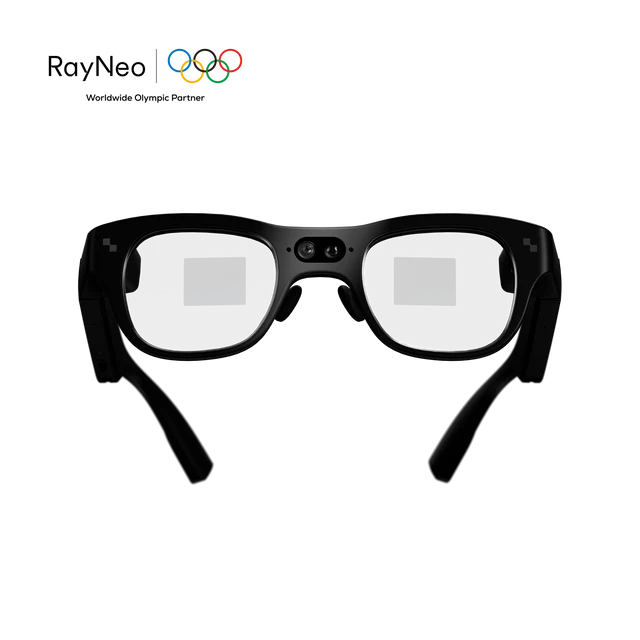


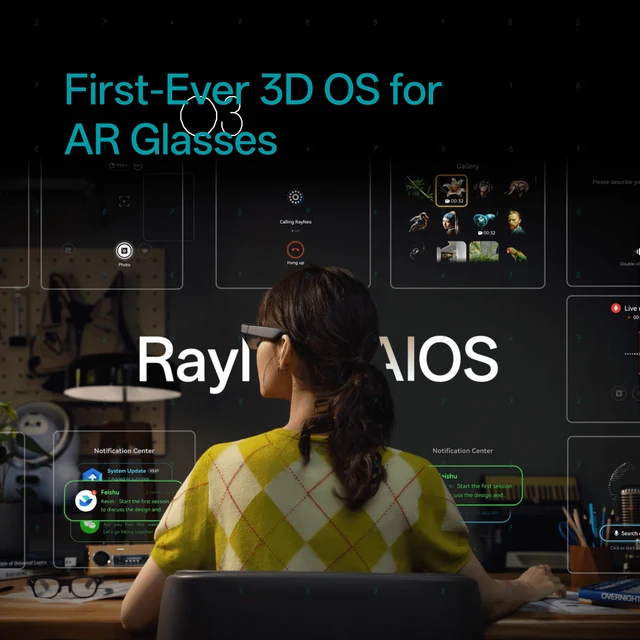
RayNeo X3 Pro — retail model shown (the eSIM concept is not yet on sale).
The part of the announcement most coverage skipped
The prototype did not arrive alone. In the same release, RayNeo announced a funding round joined by Unicom Innovation Capital, a subsidiary of China Unicom, and the investment arms of China Mobile. Two of the largest mobile operators on earth bought into a glasses company the same week it showed glasses with a SIM.
That is not a coincidence of timing. It is the business model showing through the demo. Operators do not invest in accessories. They invest in things that can carry a subscription.
Why the radio matters more than the model
The last two years of consumer glasses split into two piles.
One pile is display glasses (XREAL, RayNeo Air, Viture): a private monitor hung off USB-C. Useful. Still a peripheral.
The other pile is AI glasses (Meta Ray-Ban and a swarm of pins and clips): cameras, mics, a cloud model, and a phone doing the heavy lifting. Socially acceptable. Architecturally still a satellite of iOS or Android.
Project eSIM is an attempt to leave both piles. If the glasses have their own identity on a mobile network, three things change at once.
First, failure mode. Today, when the phone dies, the glasses die. A cellular frame fails on its own battery and its own coverage, not on someone else’s pocket.
Second, identity. An eSIM is a subscriber. That means a phone number, a data plan, lawful intercept rules, roaming contracts, and a billing relationship that does not belong to Apple or Google by default. Glasses stop being an accessory SKU and start being a line item on a carrier dashboard. With China Unicom and China Mobile already on the cap table, that dashboard has names on it.
Third, who sees the world. A camera that can upload without a paired phone is a camera that can upload when you are not looking at a consent screen. That is a product feature and a governance problem in the same sentence.
None of this requires believing RayNeo’s marketing. It follows from putting a modem in eyewear.
The engineering bill nobody put on the stand
CES demos hide the expensive parts.
Power. The retail X3 Pro already struggles to feed a MicroLED waveguide, a Snapdragon AR1, and a 12MP camera from a 245mAh cell. A 4G modem is not free. Standby radios, registration, handovers, and uplink of video will eat the budget that translation and “Hey RayNeo” were already fighting over. And here the two-gram claim cuts the other way. If the whole modem story adds two grams, the battery did not grow. “Leave your phone at home” then lasts until the first long call.
Thermal and RF. Antennas in a metal hinge next to a waveguide and a face are a nasty RF problem. Detuning from skin, frame arms, and sweat is not a press-release item. It is why most “phone-free” wearables still cheat with a puck or a phone.
Coverage truth. Operator investors in China are not a roaming agreement in Europe. Until RayNeo names consumer plans and bands outside its home market, the prototype is a Las Vegas eSIM, not a product you can take from Ben Gurion to Barcelona.
On-device versus cloud. Translation and Gemini-class answers on an AR chip, without a phone, means either a small on-device model or a constant uplink. One hits battery. The other hits privacy and latency. RayNeo has not said which path the prototype actually takes when the hall Wi-Fi is turned off.
Those are not reasons to dismiss the concept. They are the checklist that decides whether this is a 2026 product or a 2028 product wearing a 2026 badge.
What this does to the rest of the category
Meta’s Ray-Ban line won the last two years by looking like glasses and behaving like a phone accessory. Google is assembling Android XR with Warby Parker and Gentle Monster on the same bet: the phone stays primary. Apple’s glasses project, as reported this month, also assumes an iPhone.
RayNeo is a second-tier brand by consumer fame and a first-tier brand by AR-glasses volume. Counterpoint put them at 24% of global AR-glasses shipments in Q3 2025, first place worldwide. They can afford to show a radio Meta has not shipped, because they are not protecting a social app graph. They are trying to make the frame the computer.
If the prototype becomes a SKU, two markets move.
Carriers get a new device class to subsidize, and a new customer-support nightmare: eSIM swaps on a sub-80-gram object with no screen large enough for a QR code.
Enterprises get a face-worn terminal that does not require a BYOD phone on a plant floor. That is the use case that will pay for the modem, not TikTok in a waveguide.
The honest verdict
Project eSIM is the first consumer-facing glasses concept at CES that treats independence as a radio problem rather than a prompt problem. That is the correct problem.
It is also still a booth device. No price. No consumer plan. No measured battery with the modem on. The retail X3 Pro already taught the market that a good waveguide and a thin battery do not add up to an all-day computer.
Write this down as a category marker, not a purchase. The question to ask for the rest of 2026 is not “which model is in the glasses.” It is “which pair can stay on a network when the phone is in another room, and what that pair records while it does.”
RayNeo answered the first half on a stand in Central Hall. The second half is the product.
Nine months later, the verdict holds. RayNeo has still not announced a date, a price, or a market for the eSIM version, and the retail X3 Pro still ships without cellular. The company did keep its volume lead, reporting first place in global AR-glasses shipments for Q1 2026. The radio is still a concept. The market share is not.
Want the same rigor applied to your own AI system?
That’s what a QAi Health Check is for.