


Free AI for Teachers Threatens Traditional Training and Content Providers

In July 2026, Anthropic made a move that looks generous to teachers and threatening to parts of the education-content market. The company introduced Claude for Teachers, giving verified K-12 educators in the United States free access to premium Claude capabilities, a library of teaching skills, and a direct connection to evidence-based curricula mapped to academic standards across all 50 states.
The offer is not limited to generic chatbot help. Anthropic describes Claude for Teachers as a classroom-planning assistant that can help educators draft lesson plans, differentiate material for students at different levels, generate exercises, build rubrics, summarize instructional materials, and align work to curriculum requirements. The product also connects to Learning Commons and trusted curricular resources, including OpenSciEd and Illustrative Mathematics, and integrates with established K-12 tools such as ASSISTments, Brisk Teaching, Canva Education, Diffit, MagicSchool, Snorkl, and TeachFX.
The disruption is not that AI can write a lesson plan. The disruption is that the lesson plan may now be free, standards-aligned, and generated at the moment of need.
The Market Heard the Message Immediately
Investors reacted quickly. Reports following the announcement described a decline in Stride shares, with coverage noting that Anthropic’s free teacher-focused AI product could overlap with parts of the commercial curriculum and learning-software market. Some reports placed Stride’s drop around 5% to 6% after the news, while also noting that the company had already been under pressure from technical issues, enrollment concerns, and contract-related setbacks.
The market reaction does not prove that Claude for Teachers will replace a full-service education platform. Schools still need assessment systems, compliance workflows, student information systems, procurement controls, accessibility support, accountability reporting, and professional implementation. But the reaction does show that investors now treat free AI as a credible competitive signal, not a side feature.
Why This Matters Beyond Schools
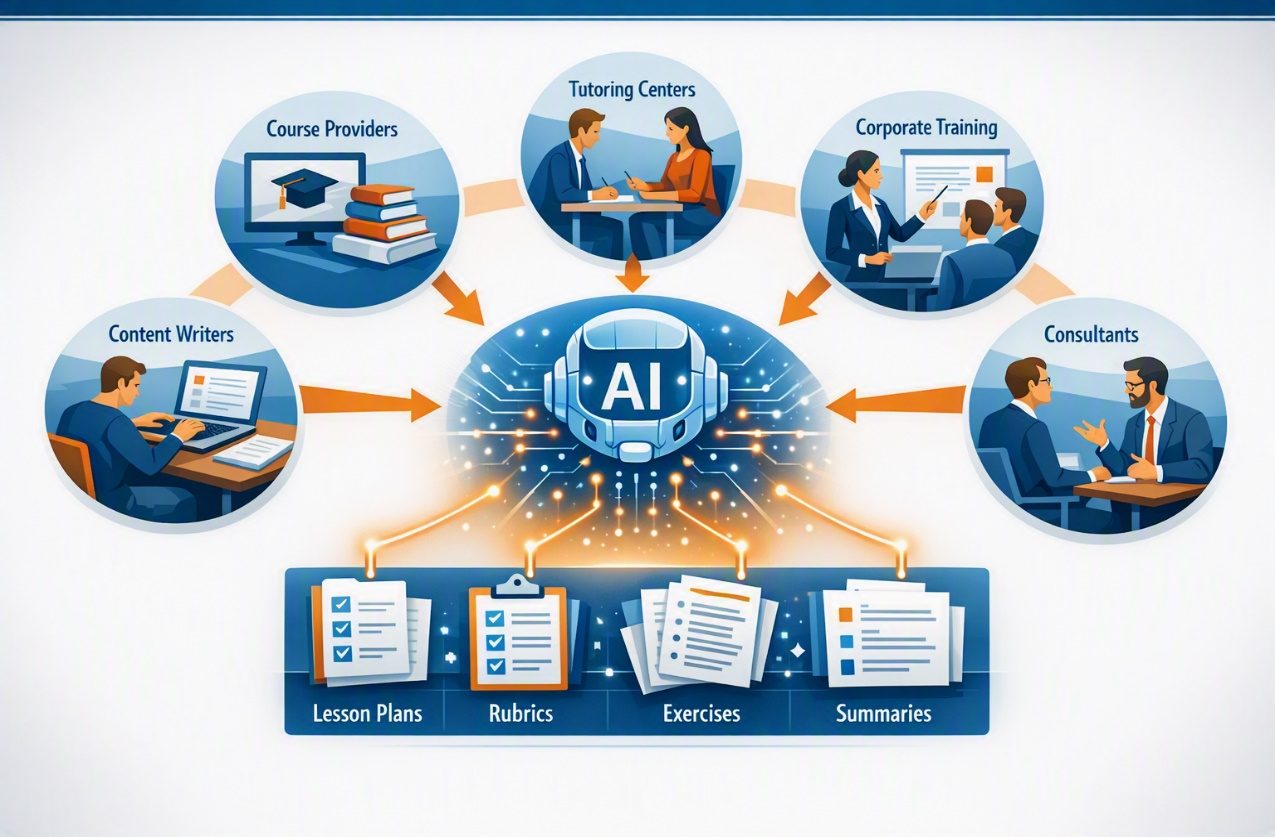
The important lesson for business is not limited to K-12 education. Any organization that sells structured learning content is exposed to the same pressure. Training companies, course providers, exam-preparation institutes, instructional designers, corporate learning departments, consultants, and vendors that sell exercise banks or templates now face a customer who may ask: why should I pay for a static package if AI can generate a tailored version for my audience today?
The New Buyer Question: What Am I Really Paying For?
For years, many educational and training products were sold as access to content: slides, worksheets, exercises, guides, templates, recordings, and curriculum maps. AI changes that value equation. If content becomes easier to generate, customers will pay less for the content itself and more for proof that the content works.
That means providers must move up the value chain. A training company cannot rely only on selling a leadership workshop deck. It must show facilitation quality, post-training adoption, manager coaching, measurable performance change, and integration into the business workflow. A test-preparation institute cannot rely only on question volume. It must show diagnostic accuracy, learner progression, question quality, and outcome improvement. A corporate consultant cannot rely only on frameworks. It must provide decision support, implementation discipline, and accountability.
If AI can create the first draft of your product, what part of your value cannot be copied by a prompt?
What Training and Content Providers Should Do Now
- Audit the product catalog. Identify which assets are mostly templates, summaries, exercises, or generic explanations that can be generated by AI.
- Separate commodities from defensible assets. Keep selling what is hard to replicate: validated content, proprietary data, expert methodology, accreditation, and facilitation.
- Add measurement. Show learning outcomes, time-to-competence, completion quality, assessment reliability, and behavior change.
- Bundle implementation. Customers may not need more content, but they still need adoption plans, governance, trainer enablement, and change support.
- Use AI inside the product. Do not compete against AI only from the outside. Embed customization, diagnostics, and workflow support into the offering.
The Opportunity Hidden Inside the Threat
Free AI does not eliminate the need for learning professionals. It changes what learning professionals are expected to deliver. Teachers may get faster lesson drafts, but they still need judgment, classroom management, adaptation, empathy, assessment, and professional responsibility. Companies may get faster training material, but they still need a learning strategy that changes behavior and improves performance.
In fact, the providers most at risk are not the experts. They are the vendors selling static content as if it were expert guidance. The providers best positioned for the next phase are those that combine domain expertise with AI-enabled personalization, measurement, and implementation.
DNLA Take
Claude for Teachers is a clear signal to every training and content business: the floor price of generic instructional material is moving toward zero. The response should not be panic, and it should not be denial. It should be repositioning. Sell outcomes, not packets. Sell expertise, not templates. Sell measurable learning, not files. AI will make content creation faster, but it will also expose which providers were selling content, and which were selling real improvement.
Want the same rigor applied to your own AI system?
That's what a QAi Health Check is for.