


Google Declares the Start of the Agentic Gemini Era

On May 19, 2026, at Google I/O, Google presented a strategy that moved Gemini beyond answering questions and into the role of an agent that can plan, search, use tools, generate software, and take action across Google’s ecosystem. The important announcement was not a single model release. It was the way Google connected Gemini to Search, Gmail, Workspace, Android, Shopping, developer tools, and everyday services so the model could become an operating layer for tasks, not only a conversational interface.
Google framed May as the beginning of the “agentic Gemini era.” In practical terms, that means Gemini is being positioned to follow tasks over time, retrieve information when context changes, operate tools, assist with coding, support shopping flows, and work inside the products people already use. The strategic move is clear: instead of asking users to come to one AI destination, Google is bringing agentic AI into the surfaces where work, search, communication, and buying already happen.
The real shift is not that Gemini can answer better. The shift is that Gemini is being connected to the systems where decisions become actions.
From Assistant to Operating Layer
Until now, most AI assistants have been judged by the quality of their answers. They could summarize, explain, draft, compare, translate, and help users think through a problem. Google’s May I/O message pointed to a different benchmark: whether the AI can stay with the task, gather the missing information, use the right tool, and produce an outcome inside an existing workflow.
Why This Is Bigger Than a Model Launch
A frontier model matters, but distribution matters even more. Google’s advantage is that it can connect AI to products already used by billions of people: search queries, email, calendars, documents, mobile devices, browsers, cloud services, and shopping experiences. If Gemini becomes the agentic layer across those surfaces, the competitive question changes. Businesses will not only ask which AI tool employees prefer. They will ask where agentic behavior already appears inside the systems employees, customers, and partners use every day.
If Gemini can act across Search, Workspace, Android, and Shopping, which parts of your customer journey or internal workflow become machine-mediated first?
The Business Risk: Invisible Dependency on Google’s Agent Layer
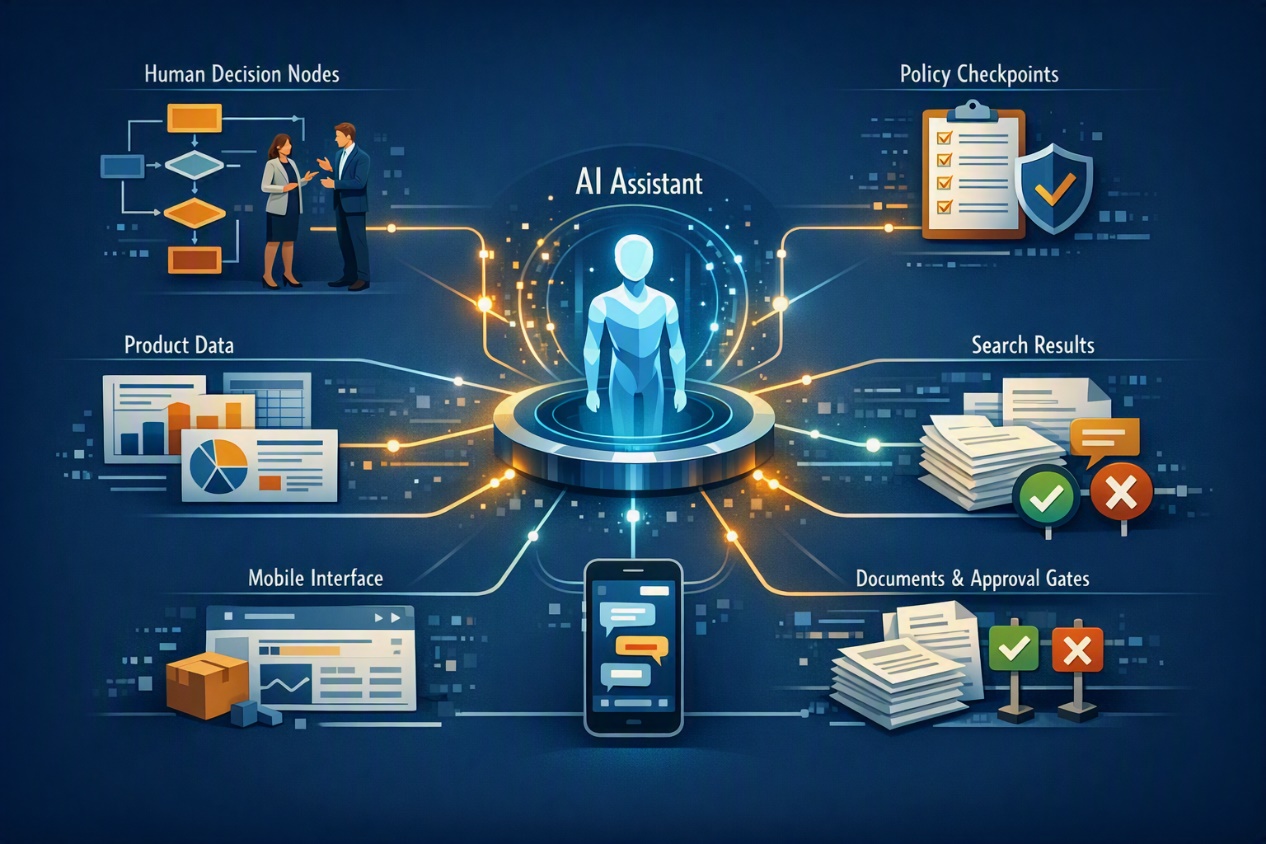
For companies, the opportunity is obvious: faster work, fewer manual handoffs, better search, more personalized customer experiences, and new ways to automate routine decisions. But there is also a dependency risk. If customers ask agents to choose products, compare providers, summarize options, or complete tasks, companies may need to become readable and trustworthy to those agents. The old digital strategy focused on ranking in search, designing attractive pages, and reducing checkout friction. The new strategy also requires structured facts, clear policies, reliable data, and agent-safe workflows.
DNLA Playbook for the Agentic Gemini Era
- Map where Google touches your business. Identify customer journeys and employee workflows that rely on Search, Gmail, Workspace, Android, Shopping, or Google Cloud.
- Make information agent-readable. Clean product data, policy pages, support content, business listings, FAQs, and operational information so AI systems can understand them accurately.
- Define what agents may do. Separate harmless assistance from actions that require approval, such as purchases, customer messages, legal claims, pricing changes, or account updates.
- Prepare for AI-mediated discovery. Assume that some customers will ask an agent what to buy, who to trust, or which provider to choose.
- Audit internal workflows. Look for repetitive search, summarization, drafting, planning, and coding tasks that Gemini-style agents could compress.
- Keep governance ahead of automation. Track permissions, review points, accountability, data access, and escalation paths before tasks become fully delegated.
DNLA Take
Google’s May I/O announcement was not simply about a smarter Gemini model. It was about placing agentic AI inside the full Google system: Search, communication, productivity, mobile, developer tools, and commerce. That makes the change strategically important for every business, not only technology companies. If agents start searching, comparing, drafting, coding, shopping, and acting across the services people already use, then businesses must prepare for a world where AI is part of the operating environment. The winners will be companies that make their information clear, their workflows governable, and their digital presence understandable to both humans and agents.
Want the same rigor applied to your own AI system?
That's what a QAi Health Check is for.