


The Cheap Model Wave Makes Cost Discipline Harder, Not Easier
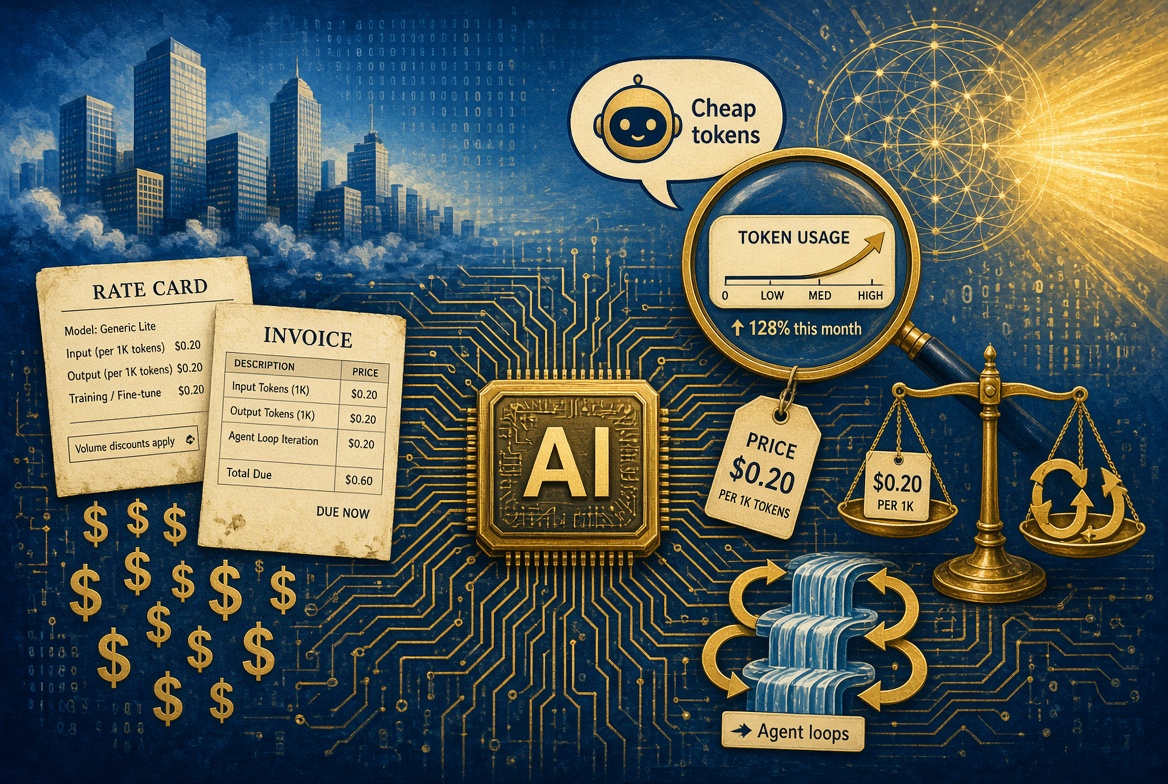
In the last two and a half weeks, the unit price of capable models moved again. On July 30, OpenAI cut GPT-5.6 Luna by 80 percent, to $0.20 per million input tokens and $1.20 per million output tokens, and cut Terra by 20 percent, to $2 and $12. GPT-5.6 Sol, the flagship, stayed at $5 and $30. On August 10, Anthropic made Claude Sonnet 5’s introductory $2 / $10 rate permanent and cancelled the increase to $3 / $15 that had been scheduled for September 1. On August 13, Google launched Gemini 3.7 Flash at an introductory $0.75 / $3.75 through December 31, 2026, half the launch price of 3.6 Flash, with the rate set to double on January 1, 2027.
Finance teams will read those numbers as relief. They should read them as a warning. A cheaper token invites more loops, more routed drafts, and more unsupervised agents, usually without a new owner for the bill.
When the sticker price falls and usage is unbounded, the organization does not save money. It loses the last remaining reason to ask whether a call should have been made at all.
What the price cuts actually changed
The cuts are real, and they are concentrated where volume lives. Luna is now cheap enough to sit under classification, extraction, first-pass drafting, and the first hop of an agent. Sonnet 5 is locked in as a workhorse instead of a promotional rate that finance had to model as a September shock. Gemini 3.7 Flash is priced to pull coding and agent traffic onto Google’s stack for the rest of the year. Google also moved 3.6 Flash onto the same introductory rate, so for now the two models cost the same, and the headline discount is really a window with an end date.
None of that changes four operating facts.
First, agentic work multiplies tokens. One user instruction can fan out into tool calls, retries, planner steps, and long reasoning traces. On Gemini 3.7 Flash, output charges include thinking tokens, so a model that reasons longer bills more for the same answer. An 80 percent cut on the cheap model does not produce an 80 percent cut on the workflow if the workflow now runs ten times.
Second, subscription seats and API meters are separate budgets. OpenAI left ChatGPT and Codex subscription prices and quotas unchanged while lowering how many credits Luna and Terra consume. A firm can feel richer inside the seat and poorer on the invoice that arrives from the API, a coding tool’s overage, or a vendor who resells the same models.
Third, introductory pricing is still a product decision. Google has already published the January 2027 step-up for 3.7 Flash. Anthropic just showed that a published step-up can also be withdrawn. Either way, the rate card is a vendor choice you do not control, and it makes a poor forecast.
Fourth, the token itself is a moving unit. Sonnet 5 and later Claude models use a newer tokenizer that produces roughly 30 percent more tokens for the same text than Sonnet 4.6. A team that moved from Sonnet 4.6 at $3 / $15 to Sonnet 5 at $2 / $10 saved less than the headline suggests, because the meter now counts more units per page.
Why cheaper models raise the governance problem

Most companies still measure AI cost the way they measured a pilot: tokens times list price, or seats times a vendor quote. That method breaks as soon as employees can pick a cheaper model without picking a cheaper task.
The failure mode is familiar. A team moves summarization and ticket drafting onto Luna or Flash because the unit cost looks small. Agents then retry failed tool calls. Developers leave coding agents running overnight. A mid-market firm discovers that “almost free” inference is the largest new line in cloud spend, and nobody can say which process produced it.
There is also a quality-cost swap that never appears on the rate card. A cheap model that needs three human edits, two extra retrieval hops, or a second pass on a frontier model ends up expensive. A mid-tier model that finishes the job once may be the cheaper choice. Without routing rules, evaluation, and a named owner, the organization buys the low sticker and pays the high total.
The same gap shows up in vendor conversations. A supplier can now say the model is 80 percent less expensive than last month and still be silent about retries, context window waste, uncached prompts, and write actions that trigger downstream systems. Price is the part of the stack the vendor is happy to discuss. Control of usage is the part the buyer has to own.
If every approved model in the firm got 50 percent cheaper tomorrow, who would stop an agent from spending the savings in a single weekend?
The false comfort of “intelligence per dollar”
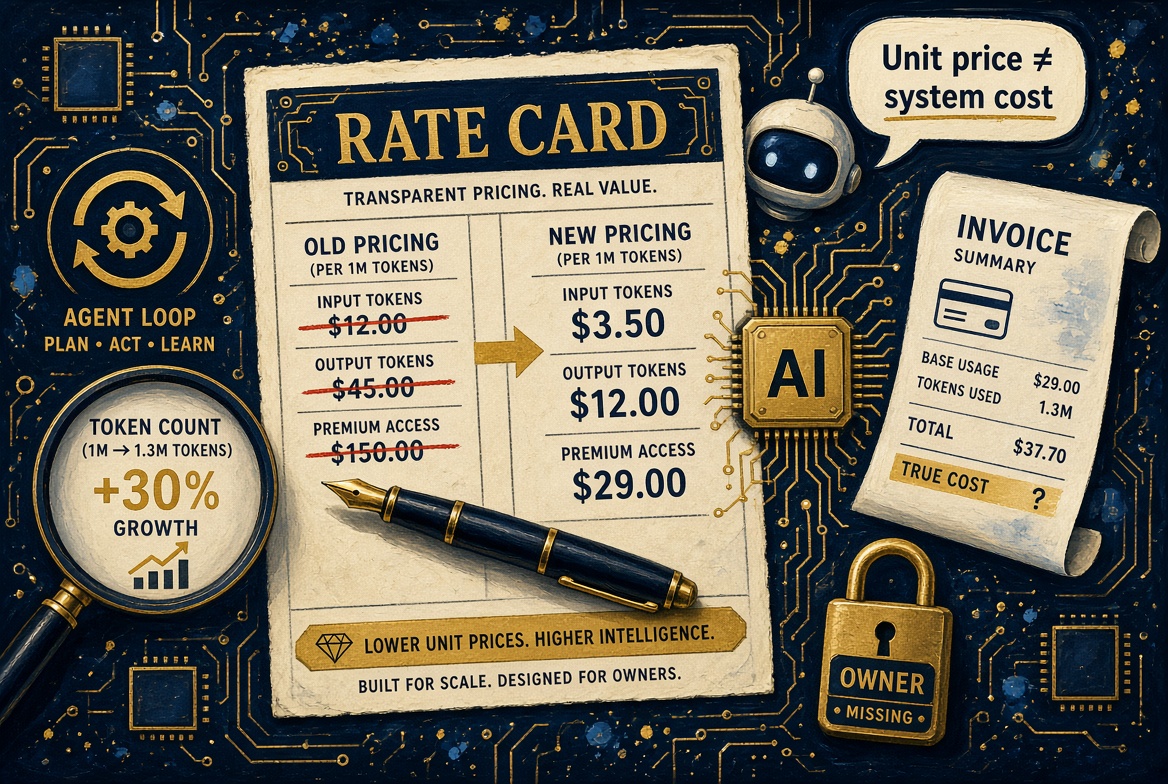
Labs will keep talking about intelligence per dollar. The phrase serves their efficiency story well and makes a poor management metric.
Intelligence per dollar does not tell you whether the task should run on a frontier model, a workhorse, a classifier, or no model. It does not tell you whether the output was reviewed. It does not tell you whether the agent had permission to call a tool that writes. It does not tell you whether last month’s invoice maps to a process that still exists.
Cost discipline for AI looks more like FinOps than like procurement. You need an inventory of models in use, a default route for each class of task, caps on agent loops, logging that ties tokens to a team and a workflow, and a rule for when a cheaper model is forbidden because the downside of a wrong answer is larger than the saving.
That is slower than switching the default dropdown to Luna. It is also the only way a price cut becomes a saving instead of a usage spike.
DNLA Playbook for Model Cost Control
- Separate unit price from workflow cost. Measure dollars per completed, reviewed outcome, not dollars per million tokens.
- Assign an owner to every production model path: who can turn it on, who pays, who can turn it off.
- Route by task class. Classification, extraction, drafting, and high-stakes advice should not share a default model.
- Cap agent loops and retries. A cheaper model with unbounded tool calls is an open tab.
- Log tokens against team, system, and vendor. If finance cannot see the path from invoice to process, you do not have control.
- Budget on the published standard rate and book any promotional discount as upside. Re-measure token counts whenever you change model generation.
- Re-run the build-versus-buy math when the workhorse tier moves. A price cut can justify staying with a vendor. It can also hide the fact that the system still cannot prove value.
DNLA Take
The cheap-model wave of late July and mid-August tests whether the company has an AI cost system at all, and the finance committee should treat it as a test.
Lower list prices make it easier to start more work and harder to notice that the work has no owner, no cap, and no measured outcome. Firms that already track usage by process will convert the cuts into margin. Firms that only watch the rate card will convert them into a larger, quieter bill.
A cheaper token is not cost discipline. Cost discipline is knowing which calls are allowed, which model is allowed to make them, and what happens when the invoice and the business case stop matching.
Want the same rigor applied to your own AI system?
That's what a QAi Health Check is for.